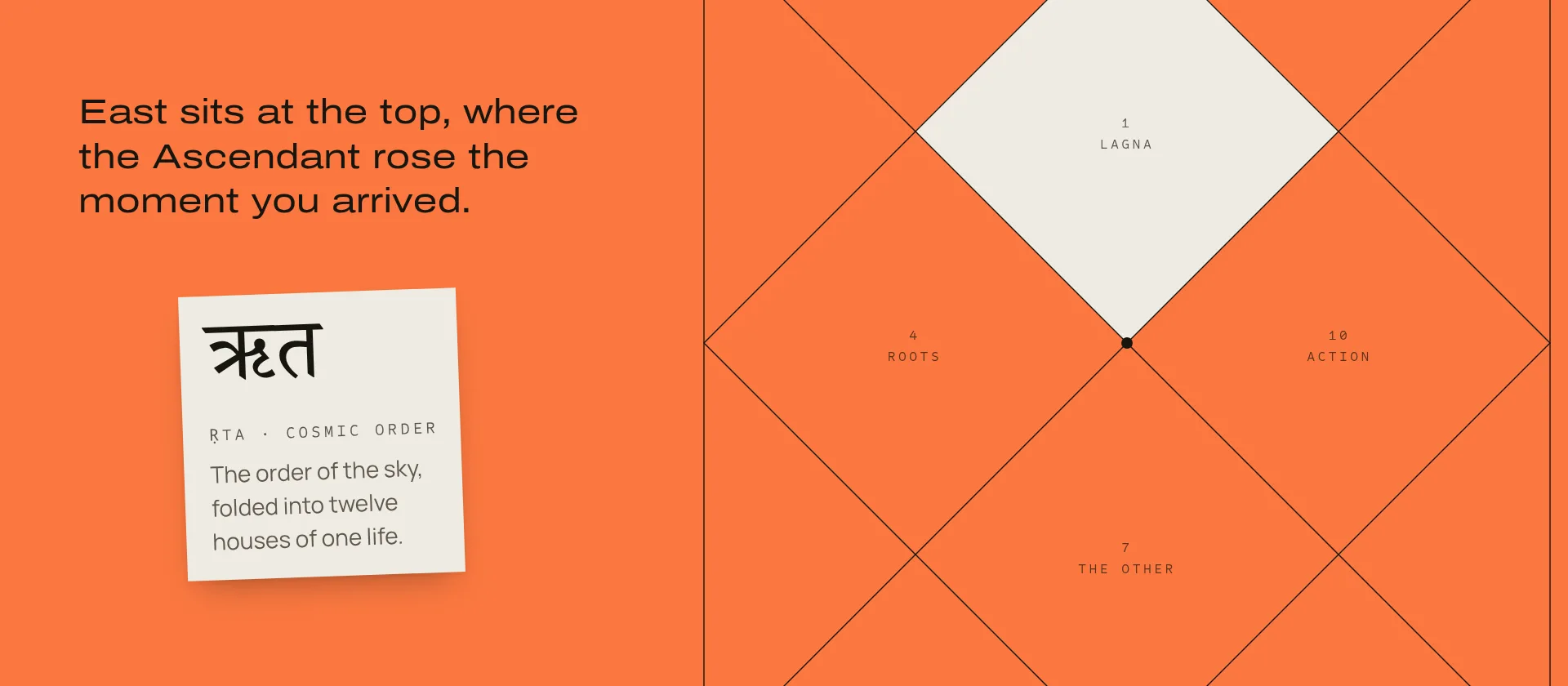
In short: a Vedic birth chart is a mandala. It folds the 360° sky into twelve equal houses, so that the order of the heavens (Ṛta) can be read as a map of one life. Its shapes, directions and subdivisions are not decoration; each one carries meaning.
The chart as a mandala
A mandala is a picture of wholeness: a centre, a boundary, and an ordered space between them. The Jyotish chart works the same way. The circle of the zodiac is divided into twelve signs of 30° each, and those twelve become the houses of your life: self, resources, siblings, home, creativity, health, partnership, transformation, belief, work, community and release. The chart is a snapshot of cosmic order at the moment you arrived.
Three regional traditions
North Indian (diamond). The houses are fixed in place and the signs move. The first house always sits in the top centre diamond, so you read the life areas by position and the signs by number.
South Indian (square grid). The signs are fixed in place, with Pisces in the top left and the order running clockwise. The houses move, and the Ascendant is marked with a diagonal line. Many students find it easiest for seeing transits.
East Indian (Bengal). A square grid with fixed signs running anticlockwise, with Aries at the top centre. Less common today, but still used in eastern India.
All three hold the same information. They are different ways of drawing one sky.
Directional geometry and Vastu
Jyotish shares its compass with Vastu, the Vedic science of space.
- East is the Ascendant (Lagna). The point rising at birth: beginnings, the body, the self.
- South is the tenth house. The highest point of the sky at birth: action, career, visibility.
- West is the seventh house. The point setting at birth: partnership and the other.
- North is the fourth house. The point below the horizon: home, roots, inner life.
This is why a planet's directional strength (Digbala) depends on where it sits. Jupiter and Mercury are strong in the east, the Sun and Mars in the south, Saturn in the west, the Moon and Venus in the north.
The visual language of sacred shapes
- The circle is time: cycles that return, like the Moon, the year and the dashas.
- The square and the diamond are the material world: stability, structure, the four directions.
- The triangle is fire and direction. The trines (houses 1, 5 and 9) are the most fortunate houses in a chart.
- The lotus is expansion: petals of 8, 16 or 108 appear in yantras and in the divisions of the sky.
- The bindu is the central point: the soul's entry into form, the still centre every chart turns around.
Nested time and fractal maths
The zodiac divides like a fractal. Twelve signs hold 27 Nakshatras of 13°20′ each. Each Nakshatra has four padas of 3°20′, giving 108 padas in total, the same number as the beads of a mala.
Each pada also corresponds to a sign in the Navamsha (D9), the ninth-harmonic chart used to read the soul's maturity, marriage and the inner strength of each planet. A planet in the same sign in both charts is called vargottama and is considered especially steady.
Time nests the same way. The Kālachakra, the wheel of time, turns through great planetary periods (mahādashas), which hold sub-periods (antardashas), which hold smaller periods still: gears within gears.
Why it matters for you
When you look at your chart, you are not looking at a grid of symbols. You are looking at the shape of the sky as it held you. Start with the centre: your Ascendant, your Moon and its Nakshatra. Then let the geometry widen outward.